Tag: AT-Intro

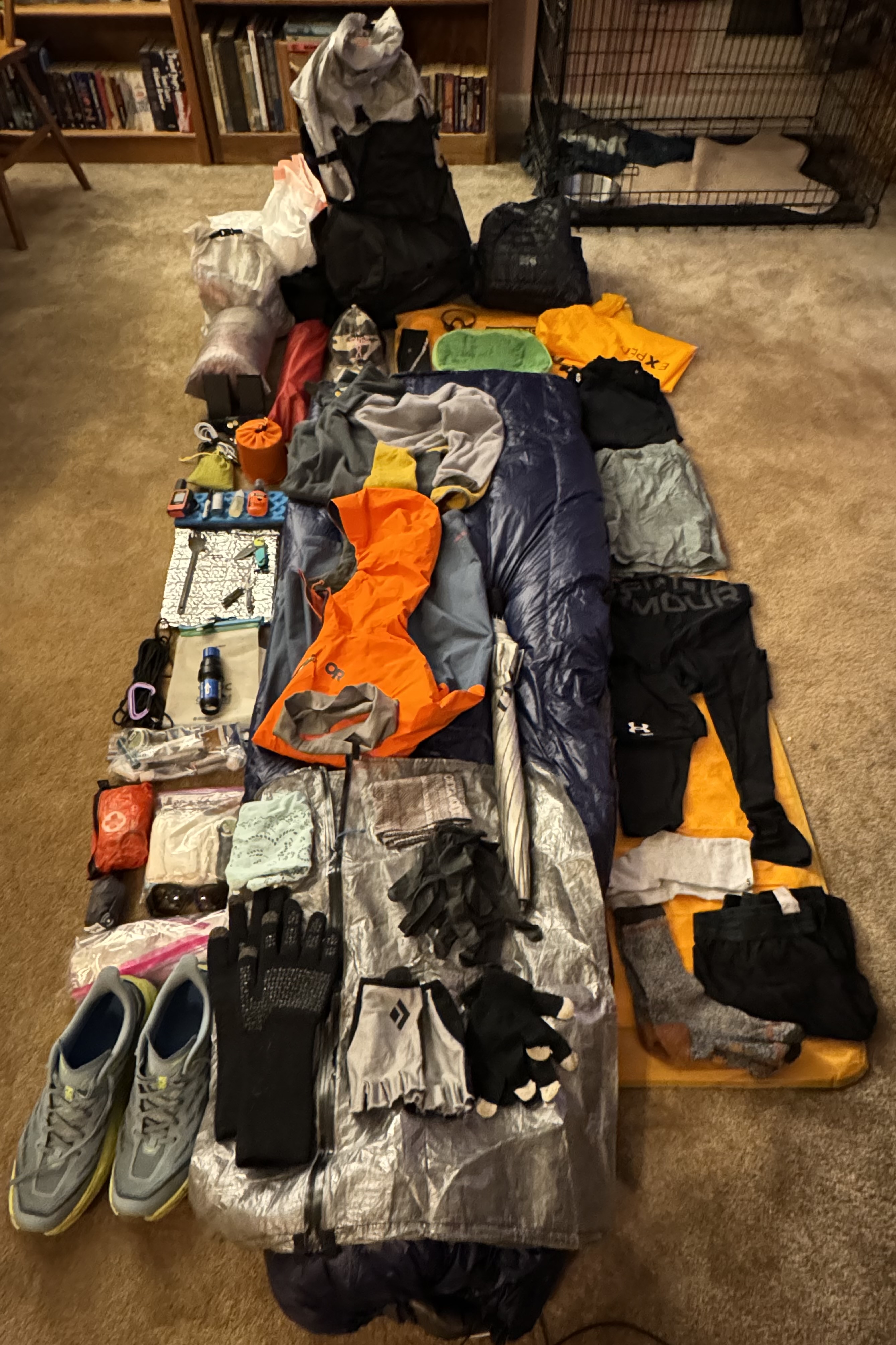
  • Gear List for 2024 AT Thru-Hike

    Gear List for 2024 AT Thru-Hike

    I started my thru-hike on April 14, 2024 with my cold weather gear. I planned to ship the cold weather gear home when I got to Damascus, Virginia. I decided to start my hike without any cap shoes in order to save weight. Overall, my base weight was 21 lbs and my total weight with 4 days of food was 31 lbs.

    Half-way through the Smokies, I stopped in Gatlinburg, TN on May 9, 2024 and shipped a few items home. Overall I got rid of 2lbs 11 ounces of gear. I did pickup a pair of cheap flip-flops at Walgreens.

    • Sent home: puffy, mittens, sun glasses, stuff sack from my quilt, straps for attaching quilt to sleep pad, some food, and some hygiene items. I only used the puffy twice and don’t see any need for it. I am good with my fleece.

    I swapped out my cold weather gear in Johnson City, TN on June 2, 2024. I also started carrying a pair of trail sandals for my camp shoes. Overall, I only dropped about 12 ounces of weight from my gear due to adding the camp shoes and my fan.

    • Sent home: long sleeve shirt, short sleeve shirt, seal skinz rain gloves, thermometer, balaclava, buff, 10 degree quilt, flip flops, old hiking pants that were too big, old bandana
    • Added/replaced: 40 degree quilt (22 ounces), hiking sandals (10.8 ounces), new short sleeve shirt, new hiking pants that fit, new bandana, new trash compactor bag, USB fan (1.76 ounces)

    I exchanged some more gear in Front Royal, VA on July 9, 2024. Lowered my base weight by about 16 ounces.

    • Sent home: rain jacket, ball cap, Apple Watch and charger, convertible pants/shorts, spare hiking socks
    • Added: lightweight shorts (4.8 ounces), camp towel (7 ounces)

    By the time I reached Duncannon, PA on July 21, 2024 I was done with my original pack. My back was killing me. I went to the local REI and picked up a beefy Osprey Atmos AG 65 pack. This added 2.8 lbs to my base weight, but it was worth it! Probably carrying a total of 32-33 lbs at this point.

    I added back some gear in Great Barrington, MA on August 15, 2024. Added about 18 ounces to my base weight.

    • Added/replaced: heavy rain jacket, hiking pants, spare socks

    Somewhere in New England I added a pair of rain pants (5 ounces).

    I swapped back in my cold weather gear in Killington, VT on August 28, 2024. I added about 18 ounces to my base weight.

    • Sent home: 40 degree quilt, hiking sandals, short sleeve shirt, USB fan
    • Added/replaced: 10 degree quilt, water shoes (14 ounces), gloves, mittens, balaclava, buff, long sleeve shirt

    Gear List – Equipment Name, Description, Quantity, Weight in Ounces, Notes

    Pack

    Pack LinerKirkland 18gal Compactor Bag12.2
    PackULA Ultra Circuit 68L + pouches135

    Sleep System

    Sleep PadNemo Tensor Insulated inflatable, regular/wide118.66
    Winter QuiltEE Revelation Down 10 degree quilt regular wide130.4
    Quilt repair patchesEE patches10.48
    Pump sack / storageExped Schnozzel Medium pump/dry bag12.1
    Nemo Sack and Patch KitComes with Nemo10.6
    PillowSea to Summit Aeros Premium12.57
    Dry BagZpacks Large dry compression bag for quilt10.8

    Shelter

    TentMSR Hubba Hubba 2150
    FootprintMSR universal 85 x 5117
    Tent Repair KitSplint, tenacious tape x 4, tenacious mesh x 210.74
    Tent StorageZpacks Medium Dry Bag10.71
    Rope frameframe for fly-first setup 10.75

    Kitchen

    StoveMSR pocket rocket 212.57
    PotTOAKS LIGHT TITANIUM 650ML POT W. Handles12.8
    SporkSea to Summit Alpha Light Spork – Long10.42
    CozyLarge cozy. Avoid simmer time on stove.10.95
    Fuelisobutane-propane 100 gram (empty)13.5
    LighterMini Bick10.39
    Wash ClothLight Load hand towel10.56
    Bear HangMtn Laurel Design Rope, rock bag, lock carabiner11.9
    Gallon BagsZiplock Freezer Bag70.31
    Food Storage BagMtn Laurel Design 12×24 DFC Bag11.1

    Hydration

    Primary Water FiltrationSawyer Squeeze12.79
    Backup Water Purification50 Aquatabs10.25
    Dirty Water ContainerCNOC Vecto 3L13.2
    Sawyer Couplingattach Sawyer Squeeze to Smart Water bottle10.18
    Spare water bottle capSpare sports cap for Smart Water bottle10.18
    Water BottleSmart Water 1L with Sport Cap21.38
    Spare O-ringSpare sawyer o-ring10.04

    Clothing

    Long Sleeve ShirtCamp Shirt Cold Weather – Under Armour Heatgear15.75
    ShortsCamp Shorts – Nike Challenger 7’’ Running Short14.8
    SocksCamp Socks – Wrightsock midweight12.93
    Toe SocksInjini sock liners – second set of hiking socks11.31
    UnderwearSpare set of dry underwear – helps with chaffing 12.89
    Long UnderwearUnder Armour Heat Gear – year round15.19
    Light Weight Mid LayerSky goat half zip fleece – large110.02
    Insect NetSea to Summit Mosquito Head Net11
    Clothing Stuff SackZpacks Slim Dry Bag 4L – replaced with schnozzel10.6

    Rain Gear

    UmbrellaZpacks Lotus UL Umbrella16.7
    Umbrella clipGear clip + small carabiner – left chest strap10.81
    CarabinerTop of pack to hold umbrella10.85
    HatBall cap, Mesh with hard bill13.5
    Rain KiltZpacks rain kilt. Doubles as tarp, ground cloth, other11.8
    Rain Jacket, HeavyOutdoor Research Foray II Gore-Tex w. pit zips112.5
    Rain Gloves8 mil Nitrile gloves from Amazon20.6

    Hygiene

    Wash ClothLight load Towel10.49
    Tooth PasteTravel size10.92
    Tooth BrushOral-B10.35
    Dental FlossGlide pro-health 54yd10.63
    SoapDr. Bronners in .5oz bottle10.95
    Insect RepellentBen’s 100% DEET – hip belt pouch11.25
    Chap StickBlistex10.35
    Anti ChaffingSquirrel Nut Butter – small container20.7
    Diaper Rash CreamA&D Zinc Oxide + Dimethicone11.83
    Hygiene BagHalf gallon Ziplock10.35
    Nail ClippersGeneric10.46
    TinactinAnti-fungal10.75

    Toiletry

    TrowelDutchwear Duce Scoop10.75
    Toilet PaperIn quart ziplock bag11
    Waste BagGallon Ziplock 10.3
    Wet WipesCottonelle12.5

    First Aide

    TweezersMetal10.25
    Mole Skin4.5’’ X 3.5’’10.18
    Self adhesive bandage1’’ X 5yds10.32
    Q-tips10 generic10.07
    Anti-diarrheal6 tablets10.14
    Motrin1000 Mg packets100.07
    Triple antibiotic ointmentGeneric packet 50.04
    Band-Aid3’’ X 1.5’’60.03
    Band-Aid2’’ X 4’’40.07
    Sterile Gauze Small2’’ X 2’’20.06
    Sewing NeedleLarge…use with floss or similar for repairs10.01
    Oral MedsPrescription – as needed (x 3)10.35
    First Aid Dry BagRed Space Bear Bags DFC small dry bag10.28
    Antibiotics100mg doxy x 610.11
    Safety PinsGeneric20.01

    Electronics

    Power BankNITECORE NB1000025.29
    Wall ChargerAnker 25W USB-C11.34
    PhoneiPhone 15 w. Case – left chest strap pouch18.11
    Head PhonesShokz OpenRun Pro bone conduction11
    GPS DeviceGarmin in-reach mini 2 + carabiner14
    HeadlampTactikka Core rechargeable12.68
    Charging Cable 14-in-1 USB-C, Lightning, Micro USB, USB-A11.31
    Charging Cable 2USB-C – USB-C10.67
    Apple Watch ChargerUSB-C and Lightning10.67
    Headphone charging adapterUSB-C to proprietary magnetic10.12
    Waterproof BagZiplock 1/2 gallon10.32

    Misc

    Duct TapeSmall roll10.56
    Multi ToolLeatherman Squirt12
    Paracord/clothes line15’11.45
    Carabiner, largeBlack Diamond Mini Wire 20x7kN load bearing20.85
    Carabiner, smallZpacks mini carabiner20.1
    Reading GlassesThinoptics + small case10.15
    LighterBic Mini – spare10.39
    PenMini sharpie 10.21

    Luxury

    Sit PadZpacks sit pad10.81
    ipadIpad mini111

    Worn/Carried

    Pants/ShortsREI Sahara Convertible113
    Long Sleeve Shirtoutdoor Research long sleeve15
    Sweat BandGeneric10.6
    SocksInjinji Trail Midweight Crew Socks13.2
    UnderwearLong bike-short style13.42
    BandanaGeneric10.85
    BuffBuff UV and Insectshield11.2
    WalletZpacks Wallet Zip Pouch – CC, ID, cash, insurance card 11
    Reading GlassesPrimary glasses, carried in left chest strap pouch11.16
    Sun GlassesOmbraz Teton, carried in left chest strap pouch12
    ShoesHoka Speedgoat 5120.6
    Trekking PolesBlack Diamond Pursuit120
    Camera MountAccessory Basics mount – right trekking pole13.95
    KnifeThe James Redstone, in pocket11.98
    Pill caseMetal pill case in pocket12.5
    GlovesFingerless hiking gloves11.2

    Consumables

    Water1 liter and .75 liter in smart water bottles1.752.2 lbs3.85 lbs total
    Fuelisobutane-propane14
    Food24oz per day4246 lbs total

    Cold Weather

    Gloves, lightweight Cloth lightweight 21.2
    Mittens, midweightConvertible mittens 12.4Swap out for summer gear
    Ear CoverGeneric  10.8Swap out for summer gear
    Balaclava Generic  11.48Swap out for summer gear
    PuffyMountain Hardware Ghost Whisperer 218.8Swap out for summer gear
    Long Sleeve Thermal BaseZengjo 18.1Swap out for summer gear
    Rain GlovesSealskinz Skeyton13.63Swap out for summer gear
    Dry bagZpacks small dry bag10.39


    Added/Modified Gear Throughout Hike

    PackOsprey Atmos 65 AG + pouches – 4.75lb177Swapped out ULA for this pack at Duncannon
    Summer QuiltEE Revelation Down 40 degree quilt regular wide022Swapped in for Summer and out in Fall
    Long Sleeve ShirtCamp Shirt Cold Weather – Under Armour Heatgear15.75
    Short Sleeve ShirtCamp Shirt warm weather – REI Active Pursuits T-Shirt15.25
    Camp / Water ShoesMerrell Men’s Hydro Moc014Only carried these from Killington, VT
    Camp shoes Xeros Z-Trail EV Sandals110.8Carried from Johnson City, TN to Killington, VT
    FanHot Weather – USB fan for hot humid nights11.76Carried from Johnson City, TN to New England
    TowelPackTowl17Carried from Front Royal, VA till end
    Rain PantsGeneric Nylon from Amazon15Carried in New England
  • How Does Thru-Hiking Work?

    How Does Thru-Hiking Work?

    “Amateurs study strategy, professionals study logistics.” – Omar Bradley

    I get a lot of questions about how this entire thru-hiking thing works and what have I done to prepare for it. 

    As for how I have physically prepared, I have been trying to hike two to four times a week, moderate to difficult terrain, 10+ miles each hike and carrying my full pack for the last twelve months. I have taken a week off here and there, but have stuck with this schedule fairly religiously. Overall, I feel like I am in pretty good shape to start this thru-hike.

    I also did three two-night backpacking trips on the AT and a week-long trip on the AT in the summer and fall of 2023. Due to the time of year that I was hiking in the mid-Atlantic (Front Royal VA to Duncannon PA) I was very much alone on the trail and in camp most nights. This let me get comfortable with my gear, the physical aspects of backpacking and camping, and most importantly the mental aspects. It is that mental aspect of a solo thru-hike that worries me the more than anything else.

    Some statistics about hiking the trail.

    Before I get into how this whole “how does this thru-hiking thing work”, a little bit of statistics.

    Approximately three million people visit the Trail every year. Approximately 4,000 people attempt a thru-hike of the entire AT each year. Historically about 25% of those who attempt to thru-hike the AT are successful. In fact, the completion rate appears to be dropping. Since 2016, only about one in five have finished the whole trail. Of those hikers that do drop-out for any number of reasons, 60% of them drop-out before they reach Damascus, Virginia (NOBO mile 471). There is anecdotal evidence that a significant amount of the drop-outs occur within the first 100 miles or roughly 10 days.

    Here is a great little article on why 75% of AT thru-hikers won’t make it.

    The largest age group of thru-hikers by far are under 30, but there is a significant amount of people in their late 50s and early 60s.

    Here is a nice easy read on a lot of interesting AT thru-hiker statistics for 2023.

    Gear Overview

    Everything that I need for 5-6 months on the trail, not counting  consumables, will be carried on my back. That means I need to be very careful in choosing what to take with me, what not to take with me, and how to plan and manage my gear and consumables (food, water, fuel, meds, toiletries, etc.). I have a complete gear listing on a later blog page, but I am including some major highlights here based on questions that I am frequently asked.

    Shelter – MSR Hubba Hubba 2 two person free-standing tent that weighs 2.8 pounds. Very roomy and very dry. Been using this for the past year.

    Sleep System – Nemo Tensor Insulated inflatable sleep pad at 19 ounces, Enlightened Equipment Revelation down quilts at 30 ounces for winter and 22 ounces for summer, Sea to Summit Aeros inflatable pillow at 2.6 ounces. I sleep on my side and generally prefer a quilt to a traditional heavy sleeping bag. I have one for clod weather and a different one for warm weather. Will swap as needed. Been using this setup for the past year.

    Backpack – ULA Circuit Ultra 68 liter pack with waist belt pouches and chest strap pouches at 2 pounds 3 ounces. This is an internal frame pack with a fairly sturdy waist belt. I carry a .75 liter water bottle on my right chest strap and my iphone and sunglasses on my left chest strap. Snacks in one hip pouch and frequently used items like bug spray and bandanna in other hip pouch. Just switched to this heavier backpack in January.

    Kitchen – 650ml titanium pot with lid, a long handled spoon, MSR Pocket Rocket stove, isobutane fuel canister, misc items all at a pound.

    Clothes – one long sleeved shirt, one short sleeve shirt, one pair of long thermal underwear, one pair of shorts for sleeping, one pair of convertible pants (turn into shorts), three pairs of socks (one just for sleeping), one spare pair of underwear, light-weight fleece pull over.

    Rain gear – umbrella, rain kilt, heavy rain jacket, two pairs of  8 mil Nitrile gloves.

    Electronics – iphone, Garmin InReach Mini satellite/GPS communicator, two 10,000ma power banks, headlamp, iPad mini. Originally I had just planned on taking a Kindle at 7 ounces, but Dana had a spare iPad mini at 11 ounces which will make blogging much easier and I can read books on it. Decent trade off for the extra 4 ounces. The two power banks can recharge my iphone from 0% to 100% a little over two times each. I go through about 50% of iphone battery daily while on trail due to audio books or music.

    Note on clothes and hygiene….basically I have one set of clothes to hike in and one set to sleep in. I hope to be able to get a shower and do laundry about once a week or so.

    Why is weight so important on the trail?

    I cannot stress enough how important managing weight is on a long hike. By weight I am refereeing to how much weight you are carrying, not how much you weight. There is a direct correlation between people who carry less weight on the trail and successfully completing a thru-hike. People who carry less weight have a much higher success rate than people who carry more weight. 

    “Base weight” is the weight of all of your gear minus consumables like food, water, and fuel. You’re generally considered an ultralight backpacker if your base weight is under 10 pounds and a lightweight backpacker if your base weight is under 20 pounds. Most traditional backpackers will have a base weight under 30 pounds.

    “Total Weight” is your base weight (all your gear including your cell phone) plus the weight of all your food , water, and fuel (i.e. your consumables). 

    Water is heavy. One liter weight 2.2 pounds. Food is also heavy. The general rule of thumb is 2 pounds of food per day. That said, there are plenty of ways to make food lighter without sacrificing calories. Think calorie dense food with zero or minimal water content that you can rehydrate at meal time. I personally find that I can get by on 1.5 pounds (24 ounces) per day with careful planning.

    I spent a LOT of time researching, planning, testing, failing, re-planning, re-testing and continually paying attention to the weight that I am carrying. At 55 years old with lots of hard miles on my lower body and back, weight is everything. Also, ounces quickly add up into pounds. For example, I literally cut my tooth brush in half to save 1.5 ounces. 

    In my opinion, anything over 20 pounds base weight or 30 pounds total weight is asking for trouble. 

    My starting base weight for this AT thru-hike is 19.8 pounds which includes 1.5 pounds of cold weather gear that I will ditch after the first 30-40 days. 

    I carry a 1 liter water bottle and a .75 liter water bottle for 3.85 pounds of water. I prefer to only carry 2.5 days of food at any one time or about 4 pounds. There are plenty of times where I need to carry 3 days of food at about 5-5.5 pounds and a few (3 I think) where I will have to carry 4 days of food at 6.5-7.5 pounds (not looking forward to those). And lastly, I carry one small fuel canister for my stove which weighs 7.5 ounces when full. 

    That makes my total weight for a 2.5 day section of trail roughly 28.5 pounds or 27 pounds once I ditch my cold weather gear. That assumes that all my gear is dry and I am not dragging around couple of pounds of water logged tent and clothes!

    I am not in love with my base weight, but I can live with it. I was down to about 16 pounds last fall, which I thought was great. But that was using some ultralight gear that my older body just was not happy with (not enough  support and some other physical problems). Fortunately I hiked A LOT with that gear and learned that sometimes physical comfort/necessity outweighs weight 🙂

    One caveat on that body weight topic. All weight has an impact on your feet and legs, including the body weight you are carrying. I worked hard to drop 20 pounds of body weight before my AT thru-hike because it is hard to drag that extra weight up and down steep mountains for days on end.

    Where to spend the night on the trail?

    There are shelters along most parts of the trail spaced roughly 7 to 12 miles apart. Shelters are three-sided structures that provide basic protection from the elements. One side is left open to the elements and you set up your sleeping kit on a wood floor. They range from small and basic with room for 4 people to sleep to large and fancy with porches, picnic tables, fire pits, swings and room for up to 16 people. There are locations to set up your tent at/around the shelters ranging from a few tent sites to 40+ tent sites. Many shelters (most?) have a privy (crude semi-outdoor toilet facilities) as well as some mechanism to keep your food away from bears and other animals (bear boxes, bear poles, bear cables). 

    In addition to shelters, there are sometimes official camp sites that have specific locations for setting up a tent. These may have a privy and food storage mechanisms. There are lots of unofficial camping locations with room for anywhere from 2 to 8 tents but no other facilities. Camping at one of the unofficial camping spots is known as “stealth camping” or “dispersed camping”.

    There are a lot of hostels along the trail, particularly in the south and again in New England. Hostels range from first-come-first serve bunk rooms that can sleep anywhere from 4 to 20 people, to rentable rooms with 1 or 2 beds, to small rentable cabins with a heating source. They range from very basic to almost luxurious. Hostels generally have some kind of common/social room for the hikers to congregate and socialize as well as a self-service kitchen for preparing your meals. A night at a hostel can range from $25 up to $100 depending your sleeping preference. Most hostels offer showers, laundry, loaner clothes, snacks, and basic food resupply (ramen, Knorr rice dishes, jerky, tuna packets, snack food, etc) for an additional fee. 

    Lastly, there are the traditional motels/hotels available in towns directly on the trail or within a short hitchhike or shuttle ride to town. Think Motel 6 or even non-chain mom-and-pop roadside motels. Those run anywhere from $75 to $125 a night. 

    The FarOut app is the most common tool used by hikers to navigate the trail and to find details on shelters, camp sites, hostels, towns/hotels, drinking water, food resupply, and much more. This is a mobile app for your phone or other computer device and includes comments from hikers (online version of word of mouth). This app is your most accurate and current source of info on the trail.

    In general, my plan is to find a hostel or motel every third or fourth night and sleep in my tent all other times. I will avoid sleeping in shelters, particularly in GA, NC, and TN due to the Norovirus problems on trail in those states.

    Where to go to the bathroom on the trail?

    Most shelters have a basic privy. These are intended for pooping and NOT for peeing. Go find a tree or a bush to hide behind to pee. Bring your own toilet paper.

    The problem with privies, particularly in highly traveled areas and all of the trails in GA and NC in the spring, is that they can fill up, they can smell, people can be inconsiderate slobs, and they can be the perfect place to pick up Norovirus. More on that last item later. 

    Other than privies, what options does that leave? Dig a 6-8 inch deep hole well away from the trail or water sources, and do your business there. Then cover it back up with dirt.  Welcome to the great outdoors and Leave No Trace principles!

    Side note – anything you pack in you need to pack out. Except for some rare exceptions at large parking lots on trail or state parks, there are NO TRASH CANS. 

    Where to get water on the trail?

    In most areas there are plenty of water sources on the trail. The most common are streams, springs, creeks, rainfall runoff, stagnant pool of water under a bridge. When getting water from these sources you should filter or chemically treat the water. Sometimes if the water is nasty enough (think fecal contamination form livestock), you might want to both filter and treat the water.

    The trick with natural water supplies like this is that they can be very seasonal and unpredictable. You need to research water availability constantly and plan ahead. Word of mouth about water sources is the best way to know about water availability on trail. Hiker notes/comments about good or bad water sources in the FarOut app.

    If the trail runs through a state park there will typically be well water of some sort. 

    Roadside gas stations, convience stores, and restaurants are also common locations to get water. Just refill your water bottle from the sink in their bathroom.

    A few important notes about water:

    • Water is the heavy. One liter is 2.2 pounds. 
    • Water availability varies by season. There are lots of good water sources in spring and early summer. But those same sources can be bone dry in the summer and fall.
    • The goal is to strike a balance between 1) how much water to carry versus 2) availability of water on trail versus 3) how hot it is and how much you need to drink. 

    Where to get food/supplies on the trail?

    There are two basic ways to resupply yourself on the trail. One way is to package up your supplies ahead of time at home into resupply boxes and mail them to yourself on the trail. The other is to buy what you can where you can at things like gas stations, convenience stores, Dollar Generals, hostel, outfitters, etc. 

    I prefer to resupply on trail, but there are some locations where it is just easier to ship things to myself than to get a shuttle and go into town and find a store and then get right back on trail. Therefore, I am doing a mixture of both methods. I put together resupply boxes that I will ship via USPS to various hostels as well as a US Post Office or two. These mainly contain food items other things that I will have trouble finding on a particular part of the trail. Also they contain my meds as I don’t want to carry 170 days worth of meds with me.

    My goal is to carry the least amount of food as possible to minimize weight. I also don’t like getting off trail and dealing with hitching or shuttling miles into town to resupply. There are sections of trail where I know I can resupply from a hostel or some store that is less than a mile off trail almost every day or every other day. This is my perfect world. 

    However there are some hostels and towns that don’t have good resupply options and some sections where there are no resupply options. In those cases I will use resupply boxes. For example, when I hike through the Great Smoky Mountain National Park I do not want to carry all the food that I need for 7-8 days! The other resupply option is to get off trail on day 4, get a shuttle and drive 30 minutes into Gatlinburg TN, buy supplies, get a shuttle back to the trail. I want to push all the way through the Smoky Mountains and not get off trail. To solve that, I shipped a resupply box to a shuttle driver who will deliver it to me at Newfound Gap on day 4. 

    I am very fortunate that I have a great support network at home. I made up resupply boxes for the first half of the trail and Dana will tweak their contents as needed and ship them to me at pre-arranged locations as I progress up the trail. 

  • What Is an AT Thru-Hike?

    What Is an AT Thru-Hike?

    “In every walk with nature, one receives far more than he seeks.” – John Muir

    I am attempting to walk continuously for 2,200 miles North Bound (NOBO) from Northern Georgia to North Central Maine along the Appalachian Trail (AT) over the course of roughly 170 days or five and a half months. This type of hike is called a thru-hike

    A thru-hike is when you hike the entire length of a given trail as one continuous hike within a 12 month timeframe. To be fair, the “continuous” part is subject to some debate, as long as you get it all done (and I mean all) in the 12 month timeframe. There may be times when you have to skip a section (think forest fire or extreme weather or logistics or many other reason), but to complete the thru-hike you need to go back and complete any part that you missed within the specified timeframe. 

    Contrast a thru-hike with a section hike. A section hike is, as the name implies, hiking section of a trail. Section hikes vary from a few days to a few weeks to a month or more. Some people hike the entire AT as a series of section hikes over the course of several years or a lifetime. Note that the technical term for these longer section hikes that last more than….say 10 days to several months….are called a LASH. That highly technical term stands for Long-Ass Section Hike. No, I am not making that up. See my FAQ blog for more trail terminology 🙂

    Back to what exactly I am doing…I am ATTEMPTING to thru-hike the Appalachian Trail NOBO, starting at Springer Mountain in Amicalola Falls State Park, GA on April 14 2024 and, if all goes according to plan (like that will happen), summit Mount Kathadin in Baxter State Park, ME on or about September 30, 2024. Note the bold on the word ATTEMPTING.

    For the more visually inclined, the trail looks like this. 

    Appalachian Trail Overview Map

    For my mid-western friends and family who might not have a good feeling for east coast distances, this is equivalent to walking from Washington DC to Kansas City, MO and back….with a bit more hills.

    I will be starting alone/solo. However, there are a lot of people on the trail starting at roughly the same time, so I will not be “alone”. Far from it. Mid-March through Mid-April is one of the most popular NOBO starting times. Here is the graph showing the number of people who registered their start dates in the spring of 2024 courtesy of the Appalachian Trail Conservancy (ATC).

    For example, there were over 80 people who registered to start on April 1, and not everybody who hikes bothers to register! That denser cluster of northbound thru-hikers is called “the bubble”.  Like a soap bubble, it can expand and contract over time and even break into several smaller bubbles. There will be many hundreds of people in the bubble…..at least initially…more on that later. There is a great Web site called Where Are The Hikers that allows you to visualize where the bubble is on the trail at any given time based on 15 years of historical data. Note, this is aggregated data NOT real-time data.

    What does that mean for me? I am intentionally starting towards the end of the traditional “bubble” on April 14, 2024 for two reasons. 

    First, I want to minimize, not eliminate, my time lugging a 30 pound backpack through 20-35 degree weather being pummeled by snow, sleet, and really cold rain for days at a time. Don’t get me wrong, I love hiking on a crisp winter day with a reasonable amount of snow (2-6 inches). But if I can avoid freezing my ass off on 15 degree nights with howling winds, no camp fire and nothing but a flimsy tent and a sleeping bag, then I am all in! The trail in Georgia and  North Carolina, particularly in the Smoky Mountains, is just not fun in the winter or very early spring. Especially when you are out there for many days at a time with no break. IMHO it can be downright dangerous.

    Second, many of you know, my great love for being surrounded by masses of people knows no bounds. Not! While I have spent a week on the trail and seen only one or two people a day and had entire camp sites to myself, that is a bit too in-peopley even for me. At least for 6 months. 

    Starting mid-April strikes a balance between the cold wet early spring in the south and the masses of people hiking at the height of the bubble. 

    Why not start even later and enjoy fewer people and warmer weather? The answer to that is that the northern terminus of the trial at Mount Katahdin in Baxter State Park Maine closes for the season depending on when the heavy snows arrive. For example, in 2023 the park closed on 10/21/2023 for the season. The guidance from the ATC is to make sure you are done with your NOBO thru-hike by October 15. Starting on April 14, hiking at a reasonable pace (starting slow and increasing mileage over time), and estimating 170 days to reach Mama K (Mount Katahdin) equates to October 1. That gives me two weeks of buffer time before October 15 in case I run into any delays on the trail. 

  • Why The Appalachian Trail?

    Why The Appalachian Trail?

    “Life is not tried, it is merely survived if you’re standing outside the fire.” – Garth Brooks & Jenny Yates

    After my wife died in 2021, I had to deal with that whole “mortality” thing and I did not like what I was seeing. I had not done any exercise since I stopped playing soccer about 6 years prior and I got winded walking up one flight of stairs. I also looked back on the past 30 years and realized that I had a lot of regrets. I was a workaholic, which caused me to miss a lot of weddings, funerals, graduations, birthday parties, etc. Add to all that the trauma of loosing my partner of 35 years and general depression around trying to figure out what the hell do I do with my life, and I decided that I needed to make some major changes.

    I retired on January 3, 2022 at 53 years old and started working on Life Part II. A major part of that included my desire to become much more healthy as well as to NOT putter around the house in my retirement. I wanted to get to a physical and mental place where I could truly enjoy life, try new things, and challenge myself. I have never enjoyed exercise for the sake of exercise (i.e. going to the gym). I decided to embrace hiking for the health/exercise benefits plus the “Spiritual” side of things. 

    I started off with 1.5 miles being difficult. Fast forward two and a half years…I have lost 25 lbs, I hike 30-45 miles a week with a 28lb pack on moderate-to-difficult terrain, and I eat better than I have in years (not a health food nut, just generally better eating habits). I have hiked/explored lots of new areas up and down the mid-Atlantic, and I am enjoying life. At some point along the way I realized that I had become a hiking addict. I love finding ever more challenging terrain as well as that “endorphin high” that comes from pushing my body. 

    I decided that I wanted to really challenge myself physically and mentally. Long-distance hiking looked like a good way to approach that, and a thru-hike of the Appalachian Trail (AT) became my initial goal (obsession?). I spent the second half of 2022 researching an AT thru-hike and doing ever more challenging day hikes to get in shape.

    Unfortunately I tore my metatarsel plate on the decent of McAfee Knob in July 2022 and stupidly hiked on it for 3 more months before seeing a doctor. After 3 months of doctored-ordered no hiking, I finally had surgery to repair the tear. That led to three more months of recovery and no hiking. By April of 2023, I was able to start hiking again. Recovery was very frustrating. Going from hiking 10 miles on difficult terrain to struggling to do 4 flat miles on the C&O Canal Towpath sucked! I started to think that there was no way I would be able to ever do the AT. 

    With the encouragement of my friends (thank you Dana!) and my orthopedist, I stuck with it. I eventually got back to hiking at least 4 days a week and struggled through several 2 day backpacking trips in the summer of 2023. Side note…dropping 25 pounds of body weight sure makes those miles easier on the feet! I capped out the year with a week-long backpacking trip from Pen Mar MD to Duncannon PA in 90 degree heat with 70-80% humidity and the worst drought we had in the mid-Atlantic in a long time (very very little water on the trail). I figure if I could survive that trip, then I was ready to attempt a thru-hike of the AT. 

    As my wonderful sister-in-law Vicki has told me many times (usually as we decide to do something questionable on a black diamond ski slope), that which does not kill us makes us stronger!