Pit Crew drove me to Dulles Airport to catch a morning flight to San Diego via Denver. Said goodbye to our dog, Pendleton. That’s always hard since he has no idea what I’m saying and probably will think I’m never coming back.
Pendleton
Hugged Pit Crew goodbye at the airport. We won’t see each other until I get to Lake Tahoe around July 10…over 2.5 months away if all goes well. Saying goodbye is hard, but not as hard as leaving her standing at the trailhead on the AT waving goodbye and knowing all I have to do is turn around and walk back to her. We just got back from a very nice vacation in the Florida Keys, so we both have those recent memories to hang onto. That trip was my partial repayment for leaving her alone to manage everything for almost half a year.
Pit Crew and Orange Man pre-hike
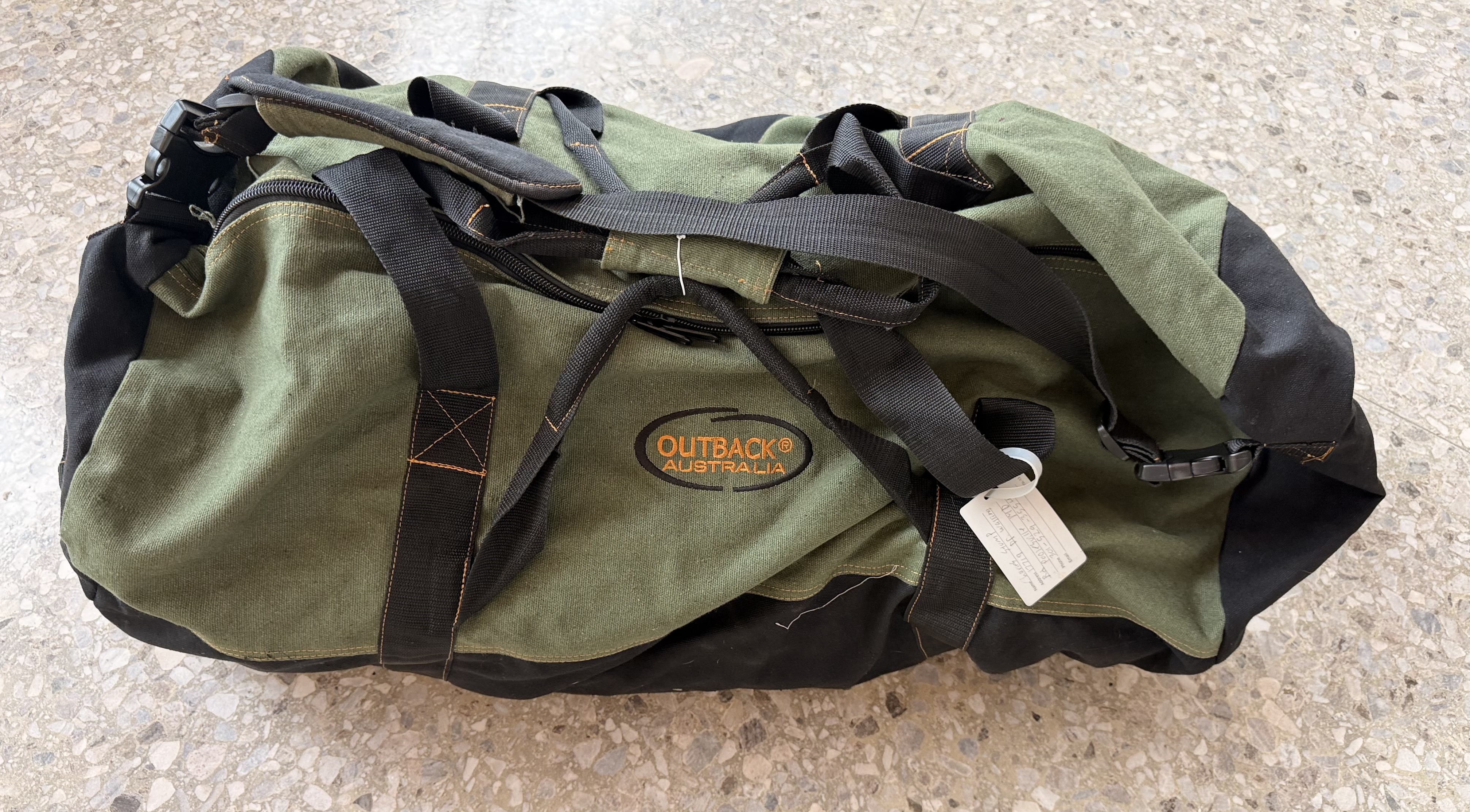
Checked my duffel bag containing my backpack and got through airport security in just a few minutes. Pulled out fuel can, lighters, water filter, meds, electronics, and my fleece. All but fuel can are in my small carry-on. Very quiet at the airport this morning. I’ll ship that duffel and carry-on home from San Diego tomorrow.
Duffel bag containing backpack for PCTQuiet morning at Dulles Airport
Had an uneventful stay in Old Town San Diego. Repacked my backpack and finalized plans for tomorrow. I have to ship my duffel bag home, get a shuttle from San Diego to the Camp Lockett Event & Equestrian and Facility (CLEEF) campground, pick up a fuel canister, and get my head ready for almost 6 months of hiking.
This article originally appeared on The Trek, which you can read HERE.
The Permitting Process
Unlike the Appalachian Trail and many other trails on the East Coast, the PCT requires a permit to hike the trail. Those permits are not easy to get for a desired start date. The PCT Association uses a random lottery system to assign permits. You can only apply for one permit once per hiking season.
The way the process works is that you randomly get assigned a time to log into the permit portal on Permit Release Day (November 13, 2025 for the 2026 hiking season). There are 35 permits available per day from March 1 through May 31. The permits for a given date are assigned on a first-come, first-served basis. That means the earlier in the day you get assigned a time slot to log in, the better your chance of getting a good start day. Later in the day (typically by 1:30-2:00), all the permits are taken for all the dates. Hence why not everybody who wants a permit gets one. It is a lottery!
I was happy with my draw in the lottery. I received a 12:20 application time, which put me a little before the halfway point, which should mean that there are a few dates in April still available. When I got into the portal, at 12:20:40, all the permits through April 23 were taken and there were only 7 permits left for April 24. I grabbed an April 24 permit quickly!
PCT Overview
The first 700 miles of the PCT are in the Southern California desert. That section is typically very dry, and water can be an issue. There are parts of that section where I will have to carry 5 liters of water (11 pounds) and be careful with that supply of water. Much of the time, there is little to no shade, and it can be very windy. Daytime highs should be anywhere between 65 and 90 with lows between 32 and 45. There are quite a few small towns, hostels, or volunteer-provided waysides in this section. The average number of days to hike that section is 48 days.
The second major section of the PCT is roughly 400 miles through the High Sierras. This includes very remote areas, long 5-6 day food carries, traversing alpine snow fields, snow-covered mountain passes, lots of water crossings from snow melt, elevations up to 14,500 feet, and some amazing scenery. I will cross through Sequoia, Kings Canyon, and Yosemite National Parks and traverse the John Muir Wilderness and the Ansel Adams Wilderness, eventually finishing in the high desert just before South Lake Tahoe. The average duration for the High Sierras is 38 days.
The third major section is 600 miles in Northern California ending at the Oregon border. Water should not be as problematic as in the desert, but with this being a drought year, it may get a little problematic. There are quite a few small towns along the way for resupply, and I only anticipate one 5-day food carry in this section. There are lots of long steep ascents/descents in this section, particularly into and out of towns where roads cross the trail at the bottom of a valley. The weather will be hot and, hopefully, dry. This is where wildfires become not just a possibility but a fact of life. The average duration for the Nor Cal section is 30 days.
The fourth major section is approximately 450 miles across the state of Oregon. This section is “flatter” than Nor Cal, but with lots of mosquito activity in the summer. This section includes Crater Lake, the Three Sisters Wilderness, and Mount Hood. This is also an area that has frequent wildfires during the summer and fall. The average duration for the Oregon section is 23 days.
The fifth major section is approximately 600 miles across Washington state in the North Cascade mountain range, ending at the Canadian border. Much of this section is remote and rugged, with constant ascents and descents. Given how late in April I am starting, completing Washington and reaching the Canadian border before the high mountain passes are closed for the season due to snow may be a challenge. The average duration for the Washington section is 27 days. That includes the two-day hike BACK from the Canadian border to reach civilization and leave the PCT.
Resupply on the PCT
My plan for resupply on the PCT is a bit different than my original plan for the AT. I only plan to mail myself supplies when 1) I need to change gear (just before and just after the High Sierras), 2) to restock up on prescription, 3) there is no other good choice for getting food. I am keeping resupply boxes to a minimum with only 11 planned, and I hope to skip a few of those. The rest of the time, I will resupply from confidence stores, outfitters, or equivalent when I can get to town. Note that getting to town will involve a LOT more hitchhiking on the PCT than I did on the AT.
Pit Crew will mail my resupply boxes a few weeks before I need them. That way, she can add things that I can’t plan out ahead of time, like new shoes, a new pair of hiking pants after I lose a ton of weight, etc.
PCT Resupply Box
Gear for the PCT
My gear, including clothes, mainly consists of items that I used on the AT in 2024 and numerous section hikes since then. The exceptions to that are a new backpack, a new fleece, micro-spikes, ice axe, bear can, and an Ursack. Other than these exceptions, I am just going to refer to my detailed PCT gear page on my personal website instead of regurgitating all the gear info here.
PCT Gear
The new backpack is the lighter version of the Osprey Atmos AG 65 pack that I used for the second half of the AT. This new version has the EXACT same beefy suspension system, but ditches a bunch of internal compartments, zippers, and other bells and whistles in order to shed about 1.5 lbs of weight. Also, I have removed the lid/brain from that pack for weight savings. Even with that weight savings, it is a heavy pack at 3.53 lbs, but I know that it does not cause me back issues. I will take that trade-off.
For the desert section of the PCT, there are no requirements on how you store your food. However, there are strict regulations in the Sierras and the first part of Northern California that require a bear-resistant hard-sided container called a Bear Can. My Bear Can weighs 2.5 lbs empty and takes up a lot of space. I am not looking forward to carrying that thing for almost 500 miles, but the fines are nasty, and I could get my permit revoked if I am caught without it. Once I get north of the Desolation Wilderness in Northern California, the hard-sided container rules go away, but there are still requirements in various areas for bear-resistant food storage. When I send the bear can home, I will switch to an Ursack. The Ursack is a lighter weight (13 ounces) soft-sided food storage container that meets the new food storage regulations in Northern California, Washington, and Oregon.
Bear Can and Ice Axe
For Mount Baden-Powell and the High Sierras, I will be using Micro-Spikes. These are steel spikes that get attached to the bottom of my shoes to prevent slipping on ice and snow. For the Sierras, I will be carrying an Ice Axe. The purpose of the ice axe is to help arrest a fall and slide down an icy/snowy slope. I will send the spikes and axe home from Lake Tahoe.
Overall Schedule on the PCT
This will be a very interesting year to hike the PCT. There has been very little snow in the Sierras and Cascades this year. Lots of rain, but warm temperatures have kept the snow to a minimum except at higher altitudes. Some areas are reporting only 20-30% of the typical snowpack for the year. That is a double-edged sword. That SHOULD mean less snow at lower elevations to have to deal with. There will always be snow at higher elevations to deal with. The lower snowpack COULD also mean that the water crossings due to snowmelt in the High Sierras will not be as deep or swift this year. Only time will tell on that item. However, the lower snowpack also means less drinking water and a higher risk of wildfires in the summer and fall.
I am starting on April 24, 2026. I feel confident about making it through the desert and making it to the start of the Sierras at Kennedy Meadows South by June 9. There are two mountains that I need to cross in the desert section that usually have snow this time of year. The first is Mount San Jacinto. As of mid-April 2026, there is no snow on that peak, so I don’t have to worry about having my micro-spikes or ice axe for that. The second is Mount Baden-Powell. That mountain still has snow and difficult terrain, so I will need my micro-spikes but not my ice axe based on recent hiking reports from that area.
Once I reach the start of the High Sierras around June 9, things start to get tricky. It is not safe/advised to start into the High Sierras until the snow has sufficiently melted. This is USUALLY around June 15. This year, with the lack of significant snow, I should be able to start into the Sierras immediately. I will not know for certain until sometime in May when the early-season hikers send back information on trail conditions. That said, they received five feet of snow over the course of two snowstorms in early April in the Sierras.
I hope to complete the Sierras and reach South Lake Tahoe around July 7. Pit Crew will fly out and meet me in Tahoe for a well-deserved double-zero day off-trail.
Without getting into too much detail, my goal is to reach the Canadian border by September 30. That is a bit aggressive, but I am worried about early-season snow in the Northern Cascades, which could bring my adventure to an abrupt and early halt. Only time will tell if I can get to Canada before the first snow!
Happy Trails
That’s all for now. Before I get on trail in the very near future, I plan to do a post with Frequently Asked Questions. I will be posting trail-log summaries on The Trek and posting daily detailed trail logs on my Web Site. Until then, keep on keeping on!
This article originally appeared on The Trek, which you can read HERE.
I told myself and my girlfriend that I was never doing another long distance hike. Or so I thought after finishing my Appalachian Trail thru-hike in 2024. Little did I realize just how addictive long-distance hiking was and how much post-trail depression would impact me.
What is post-trail depression? In general, “a common, often intense, period of sadness, anxiety, and loss of purpose experienced by hikers after finishing a long-distance, life-changing journey.” I heard about post-trail depression prior to my AT thru-hike, but I never gave it much thought. Sure enough, I started to feel its impacts the day I summited Katahdin. Those feelings got more intense in the months after. I knew the only way to fix this was to get back on the trail. I summited Katahdin on October 6, and I think I decided to do another thru-hike by early December of the same year.
Why another thru-hike?
I am fortunate to have retired early, and my body is in fairly decent condition. The reason I retired early sucks (I miss you, Andrea), but life must go on. Read my bio for more. The fact that my body can handle long-distance hiking is a bit surprising given how much abuse my body received in my 20s, 30s, and early 40s. I have become a bit of an exercise addict in retirement. I realized that the best way to stay healthy, feel good, and have a long life is to stay highly active. What better way to stay active and exercise than to lug around a 27-pound backpack for hundreds or thousands of miles at a time? A body at rest tends to stay at rest, and a body in motion tends to stay in motion.
I have an amazing support system at home in the form of my girlfriend Dana, a.k.a. Pit Crew. Pit Crew is not retired and will be working full time for several more years. She understands why I hike and encourages me to do so. She not only encourages me, but she supports me on trail whenever possible. This includes taking care of the house and the dogs when I am away, sending me resupply as needed on trail, texting with me to keep my spirits up, and making visits to me on trail. Even if those visits are half a day away from home or, in the case of the PCT, over 3000 miles away. She is always there to support me. Hence her trail name Pit Crew.
I look at hiking as my retirement gig. Be it day hikes, 5-day section hikes, 2-4 week LASHes, or thru-hikes. Pit Crew calls it my post-retirement job. When I grab my day pack and head out for a 12-mile hike, she tells me “have a good day at work”.
All that said, Pit Crew and I have an understanding. I will alternate big thru-hikes (i.e. AT, PCT, CDT) every other year and do smaller thru-hikes (i.e. CT, AZT, Long Trail) and LASHes in the off years. The plan is to get the 4-6 month monster hikes done before she retires.
Planning for the AT vs. Planning for the PCT
There are a lot of differences between the AT and the PCT. Weather, terrain, altitude, water, remoteness, and more. More on how those impact planning and logistics in another post. What I found to be the most interesting difference about planning for my first thru-hike on the AT versus my second thru-hike on the PCT was the lack of urgency and the general “it will be what it will be” attitude that I had.
For the AT, I planned things out in excruciating detail. Where I planned to stop every night, exact mileage, 20+ resupply boxes, etc. There was also the constant feeling of anxiousness leading up to the start of the hike for many months.
For the PCT, things have been just a bit different. I have had to plan out my mileage in general mainly because I have to ship gear for the High Sierras to and from trail and, being an old fart, I have to ship meds to trail every 20-30 days. But I don’t feel the sense of urgency or anxiety that I did for the AT. Even though I have never hiked in the desert before nor traversed snow-covered mountain passes at 12,000 to 14,000 feet of elevation before. I am doing minimal resupply boxes on the PCT and I have found myself letting all my resupply box preparations linger until literally the last 1-2 weeks before leaving for California. I am not worried about if I will find a place to stay in town or how I will get to/from trail and towns. It will be what it will be.
I was discussing this with a hiking friend who has kids, and it is reminiscent of the first kid versus the third kid. For the first kid, you overplan everything, obsess about healthy meals, arrange playdates, and generally hover over the child. For the third child, you are feeding them Cheetos to keep them quiet, telling them to “get out of the house and find something to do”, and thinking “no blood, no foul” or “for gods sake, just walk it off”.
Happy Trails
That’s all for now. Before I get on trail in the very near future, I plan to do a post about PCT planning and logistics and one that deals with Frequently Asked Questions. I will be posting trail-log summaries on The Trek and posting daily detailed trail logs on my blog at https://retiredhiker.com/pacific-crest-trail/ . Until then, keep on keeping on!
I plan to start my PCT thru-hike on April 24, 2026, without my Sierra Mountains gear. Since it is a very low snow year, I do not need Micro-Spikes or an Ice Axe for Mount San Jacinto. I will ship my Micro-Spikes to Wrightwood, CA, as I expect to need them to summit Mount Baden-Powell. That adds 13 ounces to my gear. I will ship the Micro-Spikes home once I got to the next town, as I will not need them again until I reach the Sierras.
For the desert section of the PCT, there are no requirements on how you store your food. However, there are strict regulations in the Sierras and the first part of Northern California that require a bear resistant hard sided container called a Bear Can. My Bear can weighs 2.5 lbs empty and takes up a lot of space. I am not looking forward to carrying that thing for almost 500 miles, but the fines are nasty and I could get my permit revoked if I am caught without it. Once I get north of the Desolation Wilderness in Northern California, the hard-sided container rules go away, but there are still requirements in various areas for bear resistant food storage. When I send the bear can home I will switch to an Ursack. The Ursack is a lighter weight (13 ounces) soft sided food storage container that meets the new food storage regulations in Northern California, Washington, and Oregon.
I will ship my Sierra gear, including my Bear Can, Ice Axe, and Micro-Spikes, to Kennedy Meadows South. I will send the Ice Axe and Micro-Spikes home from Lake Tahoe. Unfortunately, the new regulations make me keep my Bear Can until I get through the Desolation Wilderness north of Lake Tahoe. I will ship the Bear Can home from Sierra City, CA, and exchange it for an Ursack.
My starting base weight is 19.45 lbs, and my total weight with 2.6 days of food and 2 liters of water is 27.77 lbs.
My starting base weight for the Sierras is 23.07 lbs.
My starting base weight for Northern California, less the Bear Can and with the Ursack, is 19.95 lbs.
A few gear and clothing notes:
My backpack is heavy by ultralight standards but quite reasonable by traditional standards. I can’t go any lighter due to needing a beefy suspension for my bad back. Trust me, I have tried.
My body is always hot. Both while hiking and in camp. I sweat like crazy, hence the multiple bandannas, and I can’t wear a knit cap or anything else on my head unless it is way below freezing and not sunny.
After a lot of thought, I once again decided NOT to start with a puffy jacket. Most people carry a puffy for cold evenings in camp. I also see videos of people wearing a puffy on trail even though that is a BAD idea since they do not breathe at all. I used my puffy one time on the AT and just don’t need it. I have a good lightweight fleece that I can pair with my ultralight rain jacket when additional warmth is needed or I need a wind blocker.
I prefer to wear long hiking pants unless it is well into the upper 80s and humid. The long pants also help with things like poison ivy, poodle dog-bush, mosquitoes, etc. Plus the hiking pants breathe, unlike rain pants. I wear convertible pants that allow me to remove the lower legs (mid-thigh) when I am too hot.
My electronics are a little heavy, but I use my phone all day for audiobooks or music. I take lots of pictures and do my blogging throughout the day. The two 10,000 mAh batteries can get me through 5 days if I am careful. I can stretch that to 6 days if I am extremely careful.
In hot humid weather, I carry an ultralight USB-powered fan. It does not weigh much and is a lifesaver for me. I just can’t sleep in hot humid weather in a tent with no breeze.
I always carry a decent-sized (3′ x 4′) lightweight towel. Some hostels and other locations on the trail have showers, but you need to provide a towel. It is great if I want to jump in a creek/river/lake to cool off. And did I mention I sweat like crazy in humid weather?
My rain gear is highly tuned to fit my needs and experience. I can use my umbrella for the vast majority of rain situations. Some people think they are useless or a waste, but I have many thousands of trail miles and my umbrella has only failed me in very high winds above the tree line. Plus it makes for great shape in the desert or above the tree line. For cold driving rain, I have a very light rain jacket and a pair of pop-up rain pants. The rain pants also come in handy when doing laundry.
A more detailed description of most of my gear including pictures can be found on my overall Gear page.
Gear List – Equipment Name, Description, Quantity, Weight in Ounces, Notes
Pack
PackLiner
Kirkland 18gal Compactor Bag
1
2.2
Pack
Osprey Atmos AG 65 LT minus brain
1
56.5
Trekking Pole Holders
Toggle bungee front and back
2
0.07
Water Bottle Holder
Mountain Mike Hiking bottle holder
1
0.5
Phone Holder
REI Rain Shield
1
.9
Sleep System
Sleep Pad
Big Agnes Zoom UL Insulated Wide 25×72
1
17.4
Spring Quilt
EE Revelation Down 20 degree regular wide
1
22.62
Quilt repair patches
Gear Aid tape x 4
1
0.14
Foam Pad
Gossamer Gear Thinlight Foam Pad – 1/8″
1
3.3
Pump sack / storage
Big Agnes pump sack
1
2.4
Pad Patch Kit
Comes with pad
1
0.14
Pillow
Sea to Summit Aeros Premium
1
3
Dry Bag
Sea to Summit ultra-sil dry bag for quilt
1
1.5
Shelter
Tent
Durston X-mid 1
1
25.7
Tent Footprint
Durston X-mid footprint (lighter than Tyvek)
1
3.6
Tent Tie Downs
Shock cords on 4 tent tie down points
4
0.25
Guylines
guylines + carabiners for alt/windy setup
3
0.6
Tent Repair Kit
various patches
1
0.14
Tent Stakes
4 large, 7 short groundhog stakes
1
4.37
Tent Stake Bag
zippered dynema clear bag
1
0.5
Kitchen
Stove
MSR pocket rocket 2
1
2.57
Pot
TOAKS LIGHT TITANIUM 650ML POT W. Handles
1
3.21
Spork
Sea to Summit Alpha Light Spork – Long
1
0.42
Cozy
Large cozy. Avoid simmer time on stove.
1
0.95
Fuel
isobutane-propane 100 gram (empty)
1
3.5
Lighter
Mini Bick
1
0.39
Wash Cloth
Light Load hand towel
1
0.49
Bear Hang
Mtn Laurel Design Rope, rock bag, lock carabiner
1
1.9
Quart Bags
Ziplock Freezer Bag
9
0.21
Food Storage Bag
Liteaf Dyneema 19L bag
1
1.1
Use Ursack + Opsack OR Bear Can OR Food Bag depending on regulations.
Ursack
Ursack Major XL
1
7.45
Use Ursack + Opsack OR Bear Can OR Food Bag depending on regulations.
Opsack
oder proof bag for food
1
1.6
Use Ursack + Opsack OR Bear Can OR Food Bag depending on regulations.
Bear Can
BearVault 500 + Bear Can Key
1
40.3
Use Ursack + Opsack OR Bear Can OR Food Bag depending on regulations.
Hydration
Primary Water Filtration
Sawyer Squeeze
1
2.4
Backup Water Purification
50 Aquatabs
1
0.25
Dirty Water Container
CNOC Vecto 3L
1
3.35
Sawyer Coupling
attach Sawyer Squeeze to Smart Water bottle
1
0.18
Spare water bottle cap
Spare sports cap for Smart Water bottle
1
0.18
Water Bottle
Smart Water 1L with Sport Cap
3
1.38
Spare O-ring
Spare sawyer o-ring
1
0.04
Clothing
Long Sleeve Shirt
Camp Shirt Cold Weather – Under Armour Heatgear
1
6.0
Shorts
Camp Shorts – Nike Challenger 7’’ Running Short – no liner
1
4.0
Waterproof Socks
Sealskinz Unisex / camp socks
1
3.3
Toe Socks
Injini sock liners – second set of hiking socks
1
1.31
Underwear
Spare set of dry underwear – helps with chaffing
1
3.0
Long Underwear
Under Armour Heat Gear – year round
1
5.19
Light Weight Mid Layer
Mountain Hardware AirMesh Hoody
1
6.8
Insect Net
Sea to Summit Mosquito Head Net
1
1
Buff
generic
1
1.4
Camp / Water Shoes
Merrill Men’sHydro Moc
1
14
Only carry these when there are water crossings. Otherwise carry 10oz Xero Z-Trail Sandals.
Clothing Stuff Sack
Zpacks Slim Dry Bag 4L – replaced with schnozzel
1
0.54
Rain Gear
Umbrella
Zpacks Lotus UL Umbrella
1
6.7
Carabiner
Top of pack to hold umbrella
1
0.85
Hat
REI Active Pursuit Cap
1
2
Rain Pants
Generic Nylon from Amazon – good for cold
1
7.7
Rain Jacket, Medium
Montbell Peak Shell Large
1
7
Gortex with pit zips
Rain Gloves
8 mil XL Nitrile gloves from Amazon
2
0.6
Hygiene
Wash Cloth
Light load Towel
1
0.5
Tooth Paste
travel size
1
0.85
ToothBrush
Oral-B cut in half
1
0.25
Dental Floss
Glide pro-health 54yd
1
0.63
Soap
Dr. Bronners in .33oz bottle
1
0.63
Chap Stick
Blistex
1
0.35
Diaper Rash Cream
A&D Prevent Gel
1
1.5
Hygiene Bag
zippered dynema clear bag
1
0.5
Nail Clippers
Generic
1
0.46
Tinactin
Anti-fungal
1
0.75
Toiletry
Trowel
Dutchwear Duce Scoop
1
0.75
Toilet Paper
In quart ziplock bag
2
1
Waste Bag
Gallon Ziplock
2
0.42
Wet Wipes
Cottonelle
0
2.5
Stopped carrying them. Dead weight.
Anti Chaffing
Body Glide
1
1.5
Never leave home without it!
Toiletry Bag
half gallon ziplock
1
.35
First Aide
Tweezers
Metal
1
0.25
Mole Skin
4.5’’ X 3.5’’
1
0.18
Self adhesive bandage
1’’ X 5yds
1
0.32
Q-tips
10 generic
1
0.07
Anti-diarrheal
6 tablets
1
0.14
Motrin
2oo Mg packets
10
0.02
Triple antibiotic ointment
Generic packet
5
0.04
Band-Aide
3’’ X 1.5’’
6
0.03
Band-Aide
2’’ X 4’’
4
0.07
Sterile Gauze Small
2’’ X 2’’
2
0.06
Sewing Needle
Large…use with floss or similar for repairs
1
0.01
Oral Meds
Prescription – as needed
1
0.8
Inhaler
Asthma Inhaler
2
1.09
First Aid Dry Bag
Red Space Bear Bags DFC small dry bag
1
0.28
Antibiotics
100mg doxy x 6
1
0.11
Safety Pins
Generic
4
0.01
Electronics
Power Bank
Nitecore NB10000 Gen 3
2
5.47
Wall Charger
Anker 523 dual port USB-C
1
2.86
Phone
iPhone 17
1
8.6
Head Phones
Shokz OpenRun Pro bone conduction
1
1
GPS Device
Garmin in-reach mini 2 + carabiner
1
4
Headlamp
Nitecore NU25
1
1.68
Charging Cable 1
USB-C to USB-C
1
0.21
Charging Cable 2
USB-C – USB-C short
1
0.11
Apple Watch Charger
USB-C and Lightning
1
0.67
Headphone charging adapter
USB-C to proprietary magnetic
1
0.11
Waterproof Bag
Quart ziplock
1
0.21
Misc
Insect Repellent
Ben’s 100% DEET – hip belt pouch
1
1.9
Duct Tape
Small roll
1
0.8
Multi Tool
Gerber Dime
1
2.3
Cordage 2mm
30’ w min carabiner
1
1.23
Carabiner, large
Black Diamond Mini Wire 20x7kN load bearing
1
0.85
Carabiner, small
metal mini carabiner – on clothes line
1
0.11
Reading Glasses
Thinoptics + small case
1
0.15
Lighter
Bic Mini – spare
1
0.39
Pen
Mini sharpie
1
0.21
Cloth
Swedish Dish Cloth
1
0.2
Mini bungees
multiple uses
2
0.05
Bug Bite
Hydrocortisone cream
0
1.13
Carry only when needed
Luxury
Sit Pad
REI sit pad
1
1.34
Towel
Light Load Towel 3’x4’
1
4.3
Fan
Hot Weather – USB fan for hot humid nights
1
2.2
Worn/Carried
Pants/Shorts
REI Sahara Convertible
1
13
Long Sleeve Shirt
Black Diamond AlpenGlow Sun Hoodie, quarter zip
1
9.9
Socks
Injinji Trail Midweight Crew Socks
1
3.2
Underwear
Long bike-short style
1
3.42
Bandana
Generic
2
0.85
Wallet
Zpacks Wallet Zip Pouch – CC, ID, cash, insurance card
Unlike the Appalachian Trail and many other trails on the east coast, the PCT requires a permit to hike the trail. “If you plan on hiking or horseback riding 500 or more miles along the PCT in a single, continuous trip, the Pacific Crest Trail Association can issue you an interagency PCT Long-distance Permit.”
Those permits are not easy to get for a desired start date. The PCT Association uses a lottery system to assign permits. You can only apply for one permit once per hiking season. Between October 22 and October 31, 2025 you need to register for a PCT permit. This is simply the process of signing up for the lottery. You provide your basic information (name, birthdate, etc), and get registered for the lottery and assigned a login to the PCT Permit Management Portal. The portal is where you can apply for a permit, check availability of permits for specific dates, check the status of your permit/application, and make changes to your permit if you are lucky enough to get one.
For the 2026 hiking season, Permit Release Day is November 13, 2025. The day before Permit Release Day, everybody who registered for a permit is assigned a random 20 minute application time slot between 10:30 am PST and 3:00 pm PST.
The way Permit Release Day works is that there are 35 permits available per day from March 1 through May 31. On Permit Release Day, people login to the portal any time beginning at their assigned time and view a calendar that shows how many permits have been taken for any given day. You need to quickly select a date with available permits, fill out the rest other the permit application including your start point, end point, and estimated number of days to complete your hike. The permits for a given date are assigned on a first come first server basis. That means the earlier in the day you get assigned a time slot, the better your chance of getting a good start day. Later in the day (typically by 1:30-2:00), all the permits are taken for all the dates. Hence why not everybody who wants a permit gets one. It is a lottery!1
After Permit Release Day, you don’t actually have a permit. You have applied for a permit starting at a specific location on a specific date with a specific destination and duration. All permit applications are reviewed and manually approved. This takes up to 2 more weeks. There needs to be something really messed up on your application of rat to get rejected.
On November 12, 2025 I received the email for my application time slot:
Are you hoping to submit an application on the Permit Release Day tomorrow?
Your unique appointment time is: Thursday, November 13, 2025 – 12:20:40 PM Pacific Time
Log in to your Permit Management Portal and be ready to click the “New Application” button at the time that is assigned to you. If you want the most choices, you’ll apply right at that time. You could wait until later in the day, but the longer you wait the fewer permits will be left. There’s no reason to log on more than a few minutes before your assigned application time as the system will not allow you to apply any earlier.
I was happy with my draw in the lottery. A 12:20 application time put me a little before the half-way point, which should mean that there are a few dates in April still available.
On November 13, I logged into the portal a few minutes before 12:20:40 PST and hovered my mouse over the APPLY button. The moment the clock struck 12:20:40 I pressed that button and was presented with the calendar of available dates and permits. I wanted April 23, 2026 (more on why that date later). I was immediately presented with this calendar for April.
2026 PCT Lottery Calendar
Less than half way through Permit Release Day and half of the April permits were already gone, including April 23 permits. Luckily there were only 28 permits already assigned for April 24, so I jumped on that fast and completed my application. The entire process took about 3 minutes. I immediately received an email that confirmed the details of my application including:
You must start on the day and at the location listed on your permit. If you start somewhere else or on a different day, your permit is not valid and you will not be able to apply for a new long-distance permit. Now is a good time to review the Terms of the PCT Long-distance Permit (PDF).
Your application details
Name
Charles Stump
Starting location
Mexican border near Campo (CA SR 94)
Ending location
Canadian border
Starting date
2026-04-24
Ending date
2026-09-30
Out of curiosity, I looked at the available permits once I finished my application, and there were only 2 permits left on April 24. This process moves FAST!
For people who don’t get a permit in this initial lottery, there is another smaller lottery in January where an additional 15 permits per day are available. Also, any permits that were declined by the hiker are added back into the pool for the January lottery.
On November 20, I received my email from the PCTA that my permit has been approved!!!!
Your permit application is approved! It’s getting real.
Hi Charles,
We’ve looked over your application and it’s approved. Incredible!
I will start my PCT thru-hike on April 24, 2026 with a goal of completing by September 30. That completion date is not set in stone. That is an average of roughly 16.75 miles per day for 158 days. My plan is to average closer to 19 miles a day and take a zero day approximately every 10 to days. That comes to 158 days on trail with 18 zero days at 19 miles per day for 2,660 miles. That is a rough plan as there are some big wild cards including the amount of snow that the Sierra’s receive this winter as well as wildfires next summer that can mess things up. More on those later.